
The mayor’s first move
Kieth Wilson maps the territory for Portland’s budget wars.

Two days ago I made some predictions based on the DSA’s national priorities, as shown in the DSA pyramid.
The mayor released his budget yesterday. Now that we see the mayor’s priority pyramid, we can put them side by side.
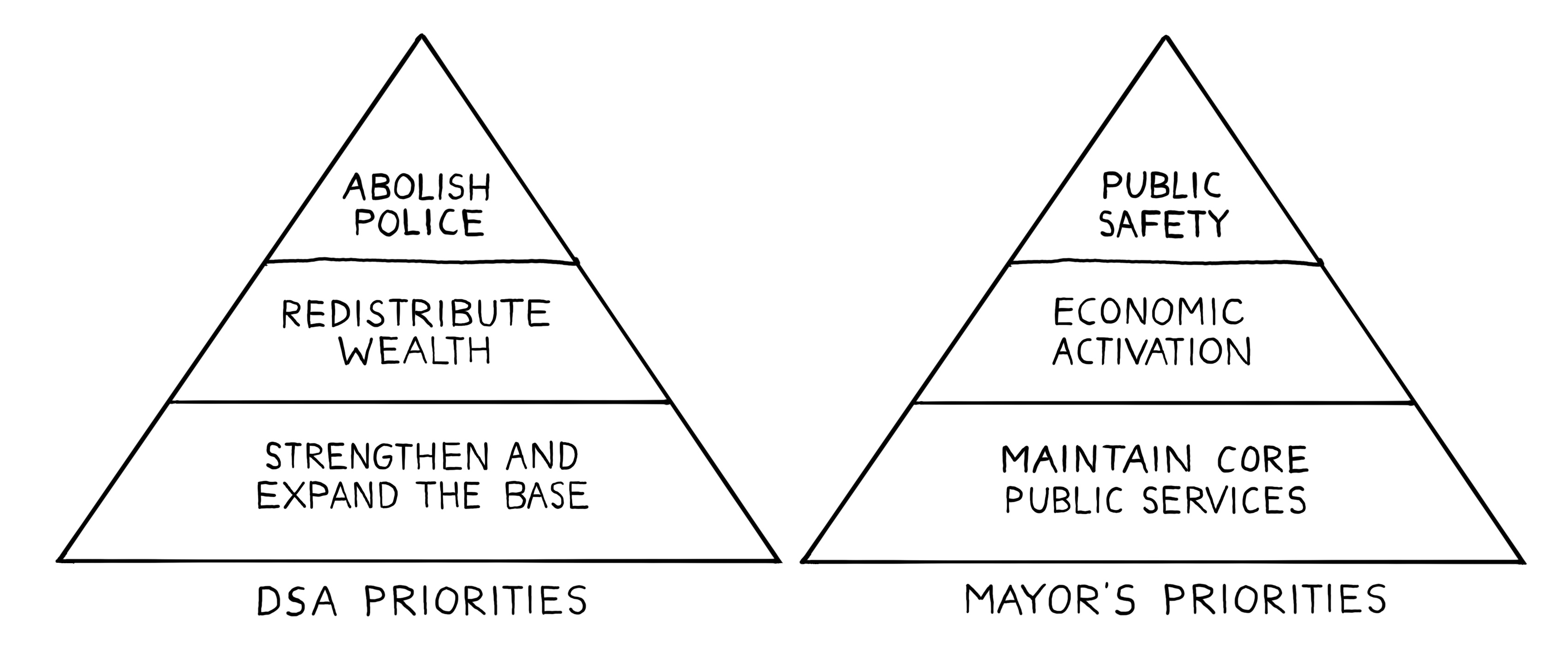
The pre-game post predicted how the Peacock bloc would move. Wilson’s budget is the first strategic move in the budget war, and it shows how he is setting up the terrain that the DSA and Peacock will move against.
Priorities.
The mayor is prioritizing public safety, investing in economic development, and preserving core services, like parks, community centers, road maintenance, and other routine functions Portlanders encounter when they are not in crisis.
Priority 1: Public safety.
Office of Community-Based Police Accountability: +$11.4M. The voter-approved police oversight body, funded at 5% of the Police Bureau budget, consistent with city charter. This is the replacement for the old Independent Police Review. Wilson is standing up the oversight infrastructure the charter requires while leaving the patrol function intact.
Community livability: +$3.4M. Street sweeping expansion and the towing and demolition of 285 RVs from Portland streets, bringing the year's total to 800. The cleanup operation tied to encampment enforcement continues.
Priority 2: Economic activation.
Prosperity Investment Program Grants expanded citywide: +$1M. Matching funds for tenant improvements to commercial and industrial properties. Average grant: $45,000. This is the agency Green tried to defund in May 2025 and the bloc has attacked repeatedly. In a shortfall year, Wilson gave it a raise.
Downtown Marketing Initiative: +$200K. Joint City, Portland Metro Chamber, and Downtown Clean & Safe campaign to reactivate downtown. The Chamber is the organization the bloc has named as its adversary.
Office of Arts & Culture (restoration of double-cut from last year): +$357K. Supports local artists and the arts.
Permit Improvement Team carryover: +$120K. A dedicated group tasked with streamlining, coordinating, and improving city-wide permitting processes to reduce timelines and improve customer experience.
Priority 3: Core public services
Most of the visible surface of city government — parks, community centers, 311, streets, water — received no major expansions. Every park stays open. Every community center stays open. 311 keeps answering, on reduced hours. Water and sewer systems keep running. Wilson's move on this layer is preservation, not expansion.
The one exception is building out an executive and administrative capacity: +$2.6M. New senior leadership and planning positions — Assistant City Administrator, Chief of Staff, Chief Strategy and Change Management Officer, and two Climate Action Plan positions — to staff the executive branch the new charter requires.
Total priorities added: +$19M.
In a $171.6 million gap year, Wilson added $19 million to priorities. Every dollar is a statement.
Cuts.
Here is what the mayor was willing to cut. Programs reduced, reorganized, or eliminated to protect the priorities above.
Cuts to DSA pyramid’s strongholds.
The mayor is cutting programs the bloc has spent a year defending as the future of public safety in Portland — unarmed response, non-sworn civilian roles, violence prevention through social services rather than enforcement. Every one of them has a role in the DSA’s top priority to degrade law enforcement by building substitutes. Wilson cut all four.
Public Safety Support Specialist Program: -$4.5M. The PS3 program is the civilian alternative-response arm, non-sworn staff who handle low-acuity, non-emergency calls instead of sworn officers. The bloc has defended it as the model for future public safety. Wilson cut it 80%.
Ceasefire and Office of Violence Prevention grants: -$1.35M. Ceasefire is the gun violence intervention program that partners with law enforcement to work with people at highest risk. OVP runs the broader violence prevention portfolio. These grants were funded by one-time dollars. The coordinator position (-$189K) and external materials (-$162K) take further cuts.
Portland Street Response Aftercare Teams: -$659K. PSR is the unarmed behavioral health first-response program. The Aftercare Teams help clients access food, housing, and medical care after the initial response. Two of the teams are eliminated.
Community Health Assess & Treat (CHAT): -$500K. Portland Fire & Rescue's non-emergency medical response. Replaced by federal grant funding at a reduced level.
Cuts across every bureau — shared sacrifice.
Core Services Realignment: -$20.9M. Centralization of HR, IT, Procurement, Equity, Communications, and Engagement functions across the city. 69 positions. The largest single cut in the budget, and a structural reorganization the new charter required.
Portland Police Bureau: -$17.5M combined. External materials, technology, fleet, and administrative staffing. 50% cut to precinct administrative staff closes East and North Precincts to walk-in public access, centralizing in-person services at Central Precinct. The patrol function survives. The access points do not.
Portland Solutions City Outreach: -$1.4M (32% reduction). The Street Services Coordination Center’s contracted outreach workers, who connect unsheltered Portlanders to services. The program downsizes to a small team of city FTE.
Water and Sewer: -$6.6M combined. 20 FTE. Customer service positions, system flushing capacity, long-term planning capacity. The 6.36% combined utility rate held to forecast.
Portland Fire & Rescue: -$6.1M combined. One engine eliminated at a double-company station. Three 2-person medical rescues moved from 24-hour to peak-hours only — “brownouts” in the bureau’s own language. Apparatus replacement deferred 20%. No station closes.
Parks care, maintenance, repair, security: -$5.2M combined. Reduced landscaping, athletic field, and grassy area maintenance. Volunteer events scaled back. Contracted security eliminated at Mt. Tabor Yard and Delta Park. The bureau’s own language: park spaces “will look less cared for, become overgrown.”
Tree Permitting: -$3.2M. Fourteen positions. The program transferred from Parks to Permitting & Development last year, and fee revenue didn’t cover the cost. Timelines will slip. Title 11 compliance will slip.
Prosper Portland staff: -$2.96M combined. Ten positions eliminated in a reduction in force. Workforce development (-$260K) means cutting one of three programs: adult career paths, youth employment, or community navigation. Small business support (-$532K) eliminates technical assistance for 175 small business owners. Prosper the agency expands. Prosper the staff shrinks.
Bureau of Emergency Communications: -$1.3M combined. Two 911 call-taker positions eliminated. Training and travel cut 50%. Operational overtime cut 50%. Call answer times likely to increase.
Housing Bureau: -$1.2M combined. External materials, an embedded BTS employee, two vacant data analyst positions.
Fleet & Facilities: -$1.9M combined. Portland Building lease termination. Contracted security and janitorial services scaled back. Vacant fleet positions eliminated.
311 operating hours and staffing: -$888K. Evening hours eliminated. Four customer service positions cut. Calls after 6 PM redirect to other city lines.
Bureau of Planning & Sustainability: -$854K. District planning capacity reduced. The $200K Digital Inclusion Fund Grants program eliminated. Home Energy Score program paused.
City Attorney: -$760K. Three vacant positions, including one Chief Deputy City Attorney.
Bureau of Emergency Management: -$583K. Two vacant positions eliminated. Vehicle inventory cut in half.
Government Relations: -$316K. International Relations program eliminated. State lobbying contract cut.
Civic Life: -$322K. Primarily rent savings from past staffing cuts.
Total reductions: -$59.7M.
The mayor is putting his money where his mouth is on shared sacrifice. Every bureau shows scars, including his top-priority bureaus. A fire engine. Two 911 call-takers. Park maintenance. That is what shared sacrifice looks like in this budget document.
Revenue.
New dollars and redirected funds Wilson is building on to close the gap.
Contingency and reserve draws: +$44.4M. One-time. Reserves drawn down to close the gap, including a $7M Transportation Fund reserve, $7M from Citywide Obligation Reserve Fund, $16.1M from a compensation contingency, and $4M in American Rescue Plan interest earnings.
Multnomah County homelessness passthrough redirected to Portland Solutions: +$30.5M. General Fund dollars that historically passed through the Housing Bureau to Multnomah County’s Homeless Services Department now stay with the city. The regional homelessness partnership structurally changes.
PCEF interest transfer to General Fund: +$26.9M. One-time. Portland Clean Energy Fund interest earnings redirected to cover General Fund needs. The precedent exists — Wheeler made the first such transfer ($7.6M) by ordinance in July 2024. Each transfer requires separate council authorization. Peacock could block this one.
Fee and grant increases: +$10.1M. Includes permitting fee adjustments at Portland Permitting & Development and other cost-recovery changes across bureaus.
Total revenue and redirected funds: +$111.9M.
That is Wilson’s first move. He added $19 million to his top priorities in a shortfall year. He closed the $171 million gap with $59.7 million in cuts spread across every bureau, including his own, counting on $111.9 million in new and redirected revenue, most of it dependent on votes the Peacock bloc has already made.
The map is drawn. The council has six weeks to challenge it.
Watch the amendments. Every restoration and cut Peacock proposes will map to the DSA pyramid. They will aim to degrade law enforcement, redistribute wealth, and strengthen their base.
The pre-game post said the budget is the battlefield. We can now see the terrain from both sides. Two pyramids. One city. One pool of dollars. Six weeks.
Our voices matter. Let’s keep our eye on the ball here people.
Good summary, thanks.
Stop the DSA