
The DSA pyramid
Half of Portland’s city council has spent a year voting together on decisions that leave ordinary voters confused. One diagram explains it all.

We’ve been told Portland city government is working as designed. That the chaos we’ve been seeing is just democracy, a new system finding its feet. But some things just don’t add up. A councilor gives an articulate explanation, and a week later gives a contradictory one that’s just as articulate. What’s going on?
Six of Portland’s twelve city councilors are trying to govern, while the other six are playing a different game. Your confusion is part of their strategy.
The DSA pyramid is the playbook that reveals the game. It explains what they are doing and predicts what they will do next. Once you see it, you can’t unsee it.
Who or what is the DSA?
DSA stands for the Democratic Socialists of America, a national political organization with a written platform, a top-down command structure, and a strategy. It even has its own flag.

Candidates who want DSA endorsement sign a pledge to fight for the DSA platform. Once in office, they answer to a chapter committee. They are not public servants. They are soldiers who report to a national chain of command.

Four Portland city councilors are confirmed DSA members: Mitch Green, Tiffany Koyama Lane, Angelita Morillo, and Sameer Kanal. Two more, Candace Avalos and Jamie Dunphy, vote reliably with them. Together they are called the Peacock bloc.
Their target is not any single policy. It is a hostile takeover of government itself. Portland city government is the territory. Every DSA move aims to seize more of it.
The pyramid that reveals the game.
The DSA platform, adopted in 2021, names three priorities:
Abolish the police.
Redistribute wealth.
Strengthen and expand the base.
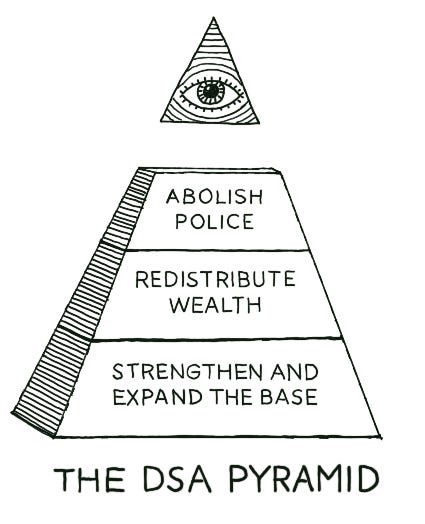
This pyramid reliably predicts the positions DSA councilors will take It predicts what they will propose, what they will block or delay, and how they will vote.
The pyramid can’t predict what evidence they will present, what questions they will ask, or what they will say. It only predicts what they will do.
But when the actions are predetermined, everything that looks like deliberation is exposed for what it is: a sham, a performance, a show.
What they say is deception. Misdirection. Smoke and mirrors.
What they do is the 100% predictable.
Here’s the plan they are executing:
Priority 1: Abolish police
Degrade and defund law enforcement by any means available. Over time, reduce funding to zero.
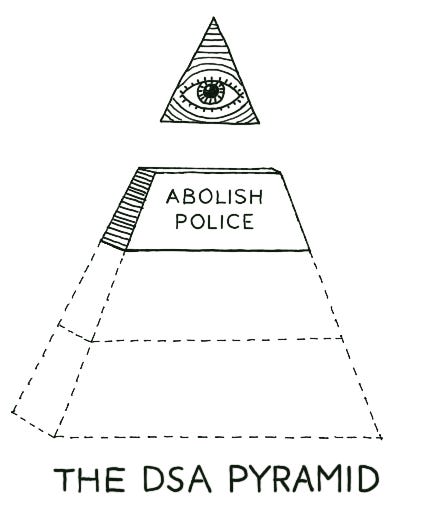
The platform calls for “constraining, diminishing, and abolishing the carceral forces of the state” and for cutting police budgets “annually towards zero.” End misdemeanor offenses. Eliminate cash bail. Remove police from hospitals, schools, and care facilities.
What this looks like in Portland:
In the 2025 budget, DSA councilors moved $2 million from police to parks. They rewrote the eligibility rules for the new police oversight board so that anti-police organizers qualify. They moved to cut $4.35 million from sweep enforcement. When Portland's annual report on local cooperation with the FBI's Joint Terrorism Task Force came up for review, DSA councilor Kanal stated on the record: “I have concerns about local law enforcement collaborating with federal law enforcement.” Not this administration. Any administration.
“The root causes of crime [are] poverty, patriarchy, and white supremacy.”
DSA Councilor Angelita Morillo, March 2026.
The platform calls for cutting police budgets annually towards zero. Abolish police.
Priority 2: Redistribute wealth
Transfer resources and decision-making from private to public and community control.
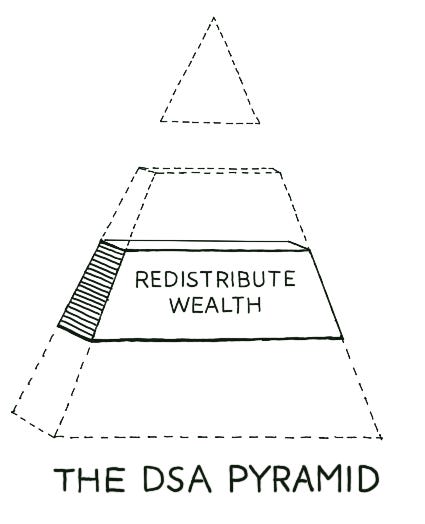
This is not about higher taxes or tighter regulation. It’s a wholesale transfer. The platform calls for “using state action to acquire private property and transform it into public democratically controlled housing,” and for nationalizing or socializing “all major industries including finance, health care, real estate, utilities, and media.”
What this looks like in Portland:
A social housing resolution to study “government acquisition of the housing stock.” Move to defund Prosper Portland, the agency responsible for attracting and retaining private business, while commissioning analysis to argue that Portland’s tax flight is a myth. Propose a tax on vacant property. Ban pricing software used by landlords and fund legal defense for tenants fighting eviction.
“We can’t tell the landlords what to do — yet. That’s a joke.”
DSA Councilor Mitch Green, April 2026.
The platform calls for acquiring private property and transforming it into public alternatives. Redistribute wealth.
Priority 3: Strengthen and expand the base
Capture the mechanics of government to fund the aligned ecosystem that produces the next wave of candidates, staff, and organizations.
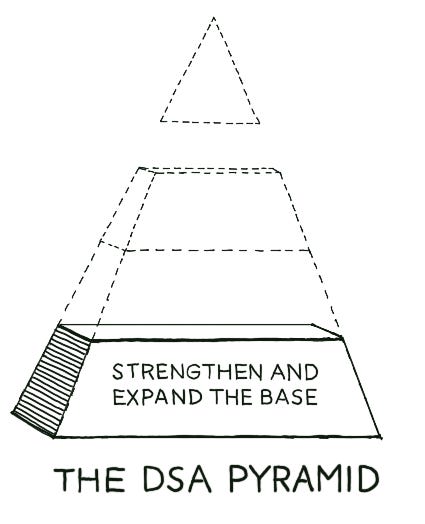
The first two priorities get headlines. The third is what locks them in as permanent gains. Priority three is how they compound.
What this looks like across four fronts:
Stack the electoral system in your favor. DSA-aligned nonprofits designed the 2022 charter reform and then ran and won under the new rules they created. None of the seats occupied by Peacock members existed before 2024.
Own the procedures. Rewrite the council’s rules in week one. Install bloc members as chairs of the committees that set the agenda and control hearings. Disqualify the mayor’s tie-breaking vote.
Capture oversight boards. Rewrite the rules so your allies qualify and your opponents don’t. Cherry-pick the board who hires the director who oversees the program.
Lock up money so only you and your allies can access it. Move voter-approved dedicated funds into ring-fenced allocations that can’t be used by your opponents, like the Children’s Levy, Portland Clean Energy Fund, and Preschool for All.
Fund a “public safety set-aside,” and then make Portland Street Response separate and co-equal bureau, so you can defund police while pretending to care about public safety.
“I think this election was not just to change who in City Hall does governing, but to fundamentally change how governing is done.”
DSA Councilor Sameer Kanal, March 2025.
DSA priority three, the base of the pyramid, is about consolidating power, locking in gains, and making them irreversible. When the DSA captures contested territory, they won’t give it back. They fortify it, wall it in, and build a moat. Strengthen and expand the base.
The chain of command
The councilors signed a contract. From the DSA’s 2021 national convention resolutions:
They must accept and pledge to promote and fight for the DSA national political platform... All DSA members in legislatures must form a caucus that votes as a block and rejects de facto discipline from any other party caucuses, regardless of which ballot line they were elected on. Failure to uphold these requirements would result in the suspension of the candidate’s DSA membership and a revocation of the endorsement.
On the ballot, a DSA candidate looks like a Democrat. But their pledge is to the pyramid.
The enforcement body is the Socialists in Office Committee (SIOC).
DSA councilors have a standing monthly meeting with the SIOC. It is the only external political group that holds regular meetings with a council bloc. The labor unions don’t do it. The chamber doesn’t. The DSA does.
Two Portland DSA members, Ben Gilbert and Jordan Lewis, are registered city lobbyists. Gilbert’s sole disclosed client is Portland DSA. He is also a SIOC co-chair.
The lobbyist is the handler.

Portland DSA co-chair Olivia Katbi Smith, on the record in Willamette Week, July 2025: “Our councilors are DSA. So what they are doing is DSA, until further notice, unless we say it’s not.”
Our councilors. Unless we say.
How to read the moves
You have the tool. Keep it handy.
When a Peacock councilor takes a stance or makes a move, look at the pyramid and ask yourself which priority it serves.
Ignore the words. Watch the moves.
A referral back to committee is a procedural kill. A co-equal bureau is a money stash for later. An economic analysis is manufactured for a predetermined conclusion. The purpose of new rules and procedures is to stack the deck. A vacancy tax punishes people for owning property. A diversion from police to parks is defunding by another name.
The words will always sound reasonable. The moves always serve the pyramid.
Now you can see the board. Our city is under attack, the gates are undefended, and no one is watching the walls. The mayor releases his budget on Monday, and hearing begin Tuesday morning. We can still win this. It’s time to show up.
Sign up to testify in person or offer written testimony.
Sources:
DSA Platform document:

2021 DSA Convention Resolutions.
With Newfound Sway in City Hall, Portland’s Democratic Socialists Hope to Redefine the City’s Priorities. Taylor Griggs, Portland Mercury, June 9, 2025.
Portland councilors vote to use new police funding to maintain parks. Alex Zielinski, OPB, May 22, 2025.
Councilor Kanal’s Proposed Tweaks to Police Accountability Board Inflame Police Union. Sophie peel, Willamette Week, February 22, 2025.
Discussion on draft ordinance to add identification of Law Enforcement Officers Code presentation. Sameer Kanal, January 13, 2026.
This Might Be Councilor Angelita Morillo’s Moment. Sophie Peel, Willamette Week, January 7, 2026.
Social Housing Resolution. Mitch Green, Candace Avalos, with co-sponsors Tiffany Koyama Lane and Sameer Kanal.
Portland Councilors Present Insights from Vienna Social Housing Junket. Jashayla Pettigrew, KOIN, September 24, 2025.
Portland City Council Votes to Adopt AI Rental Price-Fixing Software Ban. Taylor Griggs, Portland Mercury, November 19, 2025.
Portland approves plan to spend $56 million of unbudgeted housing funds. Alex Zielinski, OPB, April 9, 2026.
Tenant eviction defense funding (April 8, 2026) The 8-4 housing funds package introduced by Avalos, Dunphy, Green, and Morillo, allocating $2 million for tenant legal services plus $1.9 million for a Right to Counsel pilot guaranteeing free legal representation in eviction court. https://www.opb.org/article/2026/04/08/portland-56-million-unbudgeted-housing-funds/ https://www.portland.gov/council/documents/resolution/priority-allocations-207-million-rental-services-office-funds
Portland’s Vacancy Tax Idea: City Councilors Ramp Up For Potential Policy. Aaron Kirk Douglas, Director of Market Intelligence, HFO Investment Real Estate, July 10, 2025.
“We can’t tell the landlords what to do — yet.” Mitch Green, April 1, 2026.
Emergency Ordinance: Amend Council Organization and Procedure Code for Council Agenda, Council Rules, and Council Committees amend Chapter 3.02 2025-001 exhibit. Sameer Kanal, January 15, 2025.
Resolution: Support and expand Portland Street Response as a co-equal branch of the first responder system and establish the Portland Street Response Committee. Sameer Kanal, Angelita Morillo, Candace Avalos, June 25, 2025.
Portland Clean Energy Fund (PCEF).
My First Weeks on the City Council. Sameer Kanal newsletter, March 1, 2025.
A Democratic Socialist City Council. The Thorn (DSA blog), May 20, 2023.
American socialists aren’t tired of winning. Branko Marcetic, Jacobin Magazine, December 13, 2025.
One Thing Has Changed at Portland City Hall: The Socialists Are Setting the Agenda. Sophie Peel, Willamette Week, July 16, 2025.
Spot on as usual Brian. Our only problem with Substack is that we are preaching to the choir. How do we get these messages out to the population at large? The even more difficult problem is if we do get the message out, how do we get these people to understand that what we talk about here is completely in their own self interest!
Well done post!
The Economic Criticism:
Opponents of the DSA agenda argue that these policies create a hostile environment for investment and entrepreneurship in the Portland region.
Critics often point to several potential economic consequences:
Businesses Leaving the Region
Higher taxes, heavier regulation, and a politically adversarial tone toward business can make relocation to more business-friendly states more attractive.
Reduced Investment
When investors and developers perceive a city government as hostile to private capital, they tend to deploy that capital elsewhere.
Housing Supply Constraints
Strict rent regulations and tenant policies can reduce incentives for private developers to build new housing, potentially worsening long-term supply shortages.
Growing Budget Pressure:
Expanding government programs while weakening the tax base can create structural fiscal pressures that eventually fall on taxpayers.
The “Salting” Strategy
One tactic frequently discussed within DSA organizing strategy is known as “salting.”
In a strategic document titled “Organize for Power: A Future to Win,” associated with the Portland DSA’s 2026 steering committee slate, the chapter states that it intends to organize workers through an Emergency Workplace Organizing Committee and a “robust salting program.”
Salting is a labor-organizing tactic in which activists deliberately seek employment inside targeted workplaces with the explicit goal of organizing those workplaces from within.
A “salt” is not simply an employee with strong political beliefs. It is someone who intentionally takes a job as part of a coordinated organizing strategy aimed at building internal support for unionization or institutional change.
In many cases, that organizing intent is not disclosed to employers during the hiring process.
The Portland DSA platform also describes its goal of building power across “unions, community institutions, and grassroots activists” while forming “intentional coalitions” throughout the region.
Critics argue that this strategy raises questions about how broadly the tactic may be applied — not only within private workplaces but potentially inside public institutions, nonprofits, advisory boards, and publicly funded organizations that shape local policy.
The concern, according to critics, is one of accountability: if individuals affiliated with a political organization intentionally place themselves within influential civic institutions, residents may reasonably ask whether those individuals are primarily accountable to the public or to the political network whose agenda they are working to advance.
The Bottom Line
Portland’s current challenges — rising costs of living, declining investment, strained public services, and increasing competition from other cities — did not emerge overnight.
Critics argue that they are the predictable outcome of policies driven by ideological activism and embraced by political leaders influenced by groups like the Democratic Socialists of America.
Supporters of the DSA agenda contend that these policies promote fairness, worker empowerment, and economic justice.
Opponents argue the opposite: that the result is a shrinking tax base, a weakening business climate, and a city that is becoming increasingly difficult to live in, work in, and invest in.
Whether Portland continues down this path — or chooses a different political and economic direction — will likely shape the city’s trajectory for years to come.